FinSteam
Gas Sauna Heater — Botnia 81, 8.1 kW Off-Grid Propane | FinSteam
Gas Sauna Heater — Botnia 81, 8.1 kW Off-Grid Propane | FinSteam
Couldn't load pickup availability
Steam & Oak is the first UK retail partner for FinSteam — bringing this Finnish gas sauna engineering to British gardens, off-grid cabins, custom builds and existing-sauna retrofits.
The original FinSteam gas heater — drop into your existing sauna, or build around it
The Botnia 81 is the original FinSteam workhorse — 8.1 kW, certified, the heater that started the brand. Drop it into your existing barrel sauna, cube sauna, cabin, custom build, or off-grid setup; or buy it to specify a new sauna around. Connect a UK propane bottle outside via a 37 mbar regulator, light the heater, and you're in genuine 70-75°C Finnish sauna heat in 15 to 20 minutes. No electricity, no chimney, no flue. Turn the dial.
Upgrading your current sauna? Here's what fits where
The Botnia 81 is certified as a standalone gas appliance, which means it can be installed in any sauna structure provided you meet the FinSteam installation specifications (clearances, ventilation, base, gas connection). Common retrofit scenarios:
- Existing barrel sauna with no heater fitted (very common with imported Eastern European barrels) — the Botnia 81 R11S or R14S is the typical pick. The Njord heat shield in the S variants cuts the required side clearance right down to 50 mm — handy for the tightest barrels and curved walls, and for extra safety margin on any fixed install.
- Existing barrel / cabin with a tired wood-fired stove — replace it with a Botnia and you skip the chimney, the fire-tending, the 30-45 minute warm-up. Same sauna, a much better daily experience.
- Existing electric sauna with a dead element — replace the element + heater + the consumer-unit + the electrician callout with a Botnia. No more sauna-trips-the-fuses, no more circuit upgrades.
- Custom build / self-build — pick whichever R configuration matches your cabin volume and safety requirements. Every Botnia ships with its Orbis stone cage matched and ready, so nothing has to be sourced separately.
- Off-grid cabin / cottage / Airbnb — the Botnia is the easiest way to add real sauna heat where the mains can't reach.
Why a gas sauna heater (and why it beats wood-fired or electric)
For owners considering an upgrade, the headline comparison:
| FinSteam gas | Wood-fired | Electric | |
|---|---|---|---|
| Heat-up time | under 20 minutes, turn a dial | 30-45 minutes, tend a fire | 30-60 minutes |
| Power needed | Propane bottle | Firewood | Mains — often a dedicated 32A circuit |
| Electrician / wiring | None | None | Usually required (£1-2k) |
| Chimney | None | Required | None |
| Smoke, ash, soot | None | Yes, every session | None |
| Humidity | Naturally humid (combustion vapour stays in the cabin) | Dry until you ladle | Dry until you ladle |
| Off-grid | Yes | Yes | No |
| Control | Dial | The fire decides | Thermostat / timer |
| Safety | EU-certified, auto oxygen shut-off | Open flame | Electrical |
| Works in a power cut | Yes | Yes | No |
A clever piece of engineering — the certified safety case
Running gas safely inside a small, enclosed, oxygen-hungry space like a sauna is genuinely hard. FinSteam solved it with patented burner technology delivering clean, stable combustion, wrapped in two layers of automatic safety:
- Oxygen Depletion Sensor (ODS) — continuously monitors the oxygen level inside the sauna and automatically shuts off the gas if it drops to approximately 18% — well above any level dangerous to occupants. This is the same standard used in indoor gas appliances regulated by the EU.
- Flame monitoring — cuts the gas instantly if the flame is lost for any reason (e.g. accidental knock, sudden draft, gas supply interruption).
FinSteam's stated claim: this is the only CE-marked, electricity-free sauna gas heater on the European market. AENOR-tested under EU Gas Appliance Regulation 2016/426. Across the last 12 months, FinSteam record zero warranty returns on the heater.
Will it fit my sauna?
- Insulated saunas: 4 to 12 m³ internal volume — covers virtually every domestic barrel, cube, cabin and custom build.
- Non-insulated saunas / tents / lightweight builds: 4 to 8 m³ — the lower insulation means less working volume.
- Heating speed: 15 to 20 minutes from cold to 70-75°C in normal UK conditions.
- Stone capacity: up to 20 kg with Orbis 11 cage, 25+ kg with Orbis 14.
- Clearance to combustible timber: 200 mm sides, 1000 mm ceiling. With the Njord heat shield, the required side clearance drops to 50 mm.
If you're not sure your sauna fits the spec, send us the internal dimensions and a photo by WhatsApp or email — we'll tell you straight, before you commit.
Key specifications
- Power: 8.1 kW.
- Gas: UK propane (I3P, 37 mbar) — also factory-configured for butane/propane mix (I3P/B, 30 mbar) on request.
- Gas consumption: 0.6 kg/h at full output. A UK 13 kg propane bottle runs the heater at full output for around 20 hours; throttled at temperature, much longer.
- Dimensions: 61 × 51 × 30 cm.
- Weight: ~9.8 kg (configuration-dependent).
- Heat-up time: 15-20 minutes to 70-75°C.
- Sauna size range: 4-12 m³ insulated · 4-8 m³ non-insulated.
- Safety: EU Type-Examination Certificate (AENOR, Gas Appliance Regulation 2016/426). ODS auto-shutoff. Flame monitoring.
Which configuration should I pick? — every variant explained
The Botnia 81 ships in 4 configurations — R11, R14, R11S and R14S. The heater chassis is identical in every one, and every configuration includes its Orbis stone cage — what changes is the cage size and whether the safety pack is included:
Botnia 81 R11 — heater + Orbis 11 stone cage
The entry point to the range and the default configuration for most domestic retrofits. The Orbis 11 cage takes 20-25 kg of sauna stones, which is the right thermal density for a 4-8 m³ sauna (most barrels, smaller cubes, smaller cabins). Pick R11 if you're retrofitting a domestic barrel (typical 3-5 m³ internal volume) or a small-to-medium cabin sauna, you don't need the safety pack, and you want the most affordable fully-functional configuration.
Botnia 81 R14 — heater + Orbis 14 stone cage
The Orbis 14 holds 25 kg+ — more stones, more thermal mass, stronger löyly response when you ladle. Pick R14 if your sauna is on the larger side (8-12 m³ — bigger cabins, larger custom builds), or you specifically want a more powerful steam response from the stones. For a typical UK domestic barrel, the R11 is enough and the R14 is overkill.
Botnia 81 R11S — R11 + Njord heat shield + Halo safety rail (the safety pack)
The "S" configuration adds two standard items to the heater:
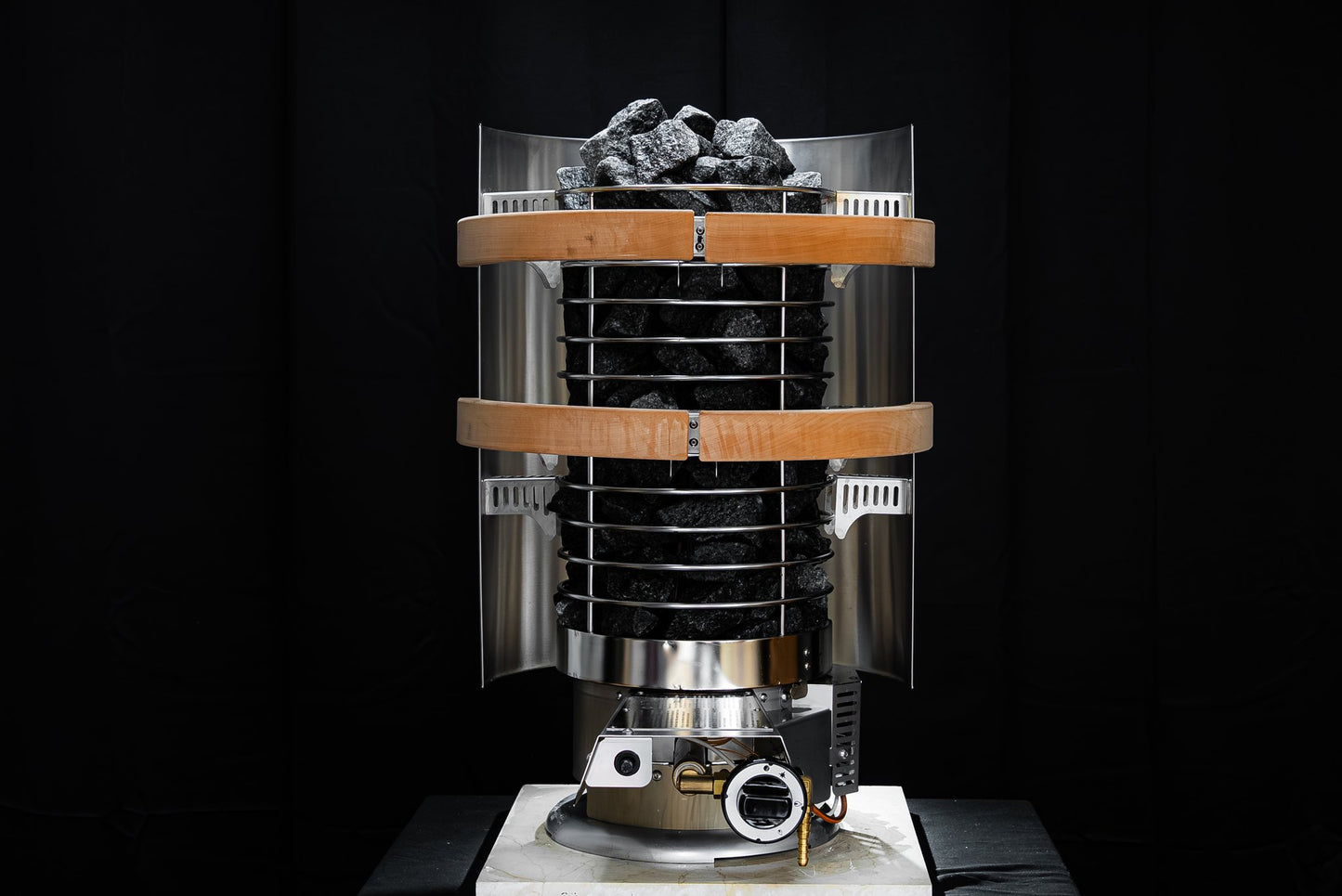
- Njord heat shield — a non-combustible steel shield between the heater and the timber walls of your sauna. Cuts the required clearance to combustible timber right down (200 mm sides → 50 mm). Useful for the tightest retrofits, and a safety margin on any fixed install.
- Halo safety rail — a wood-clad circular rail around the top of the heater. Prevents accidental contact with the hot stone cage during a session.
Pick R11S if: you're retrofitting a tight barrel sauna where the standard 200 mm side clearance is tight, you have kids using the sauna, you're running any commercial / hire / holiday-let use, or you want a Gas Safe engineer or insurance broker to look at the install and see the full safety story. Standalone, the Njord retails at ~£189 and the Halo at ~£249 — buying both separately on top of the R11 costs more than upgrading to the R11S in the package.
Botnia 81 R14S — R14 + Njord + Halo (the full safety pack with larger cage)
Same safety pack as R11S, but with the larger Orbis 14 cage. The flagship Botnia configuration. What every commercial / hire operator should choose — bigger thermal mass for repeat sessions, full safety pack for insurance compliance. Also recommended for any household-with-kids retrofit into a larger cabin or barrel.
Not sure? R11S is the sensible default for most domestic retrofits into existing barrel saunas. R14S is the default for commercial / hire use and larger builds.
The components, explained individually
Orbis 11 / Orbis 14 stone cage (included in every configuration)
The Orbis is the FinSteam-designed stone cage that sits on top of the heater chassis, and it ships with every Botnia 81 configuration — R11, R14, R11S and R14S. Fully compatible across all FinSteam heaters — including older Botnias bought before the Orbis line existed. Stone capacity 20-25 kg (11) or 25 kg+ (14). The cage is what holds the sauna stones in position above the burner — stones aren't just decoration, they're the thermal mass that gives you löyly when you ladle water on them. A gas sauna heater needs its stones and its cage to work properly, which is why the Orbis is never optional. Most other stone cages aren't sized for this heater.
Njord heat shield (included in R11S/R14S, sold standalone)
A non-combustible steel shield, designed by FinSteam, that sits between the heater and any timber surface. The shield reduces the radiated heat reaching the timber by enough that the required side clearance to combustible timber drops from 200 mm to just 50 mm. In practical terms: the standard 200 mm clearance already suits most barrels, cubes and cabins, but the tightest retrofits — curved barrel walls and compact cube saunas — benefit from the Njord. On any fixed or commercial install it's the extra safety margin a Gas Safe engineer or insurer likes to see.
Halo safety rail (included in R11S/R14S, sold standalone)
A circular wood-clad rail that fits around the top of the heater, preventing accidental contact with the hot stone cage during a session. Important in three scenarios: family use with children, commercial / hire / holiday-let use (insurers expect to see it), and tighter sauna interiors where bench positions are close to the heater.
The full retrofit picture — what you'll need on top of the heater
If you're retrofitting an existing sauna, the heater is the centrepiece but not the whole story. Plan for:
- UK propane regulator + hose kit (I3P 37 mbar, 27 mm clip-on for Calor bottles). FinSteam don't supply this — it's our UK gas kit. Sold standalone, included in every NOIR package.
- 40 kg sauna stones sized for the Orbis cage. Sold standalone.
- Non-combustible base for the heater — ≥30 mm thick, ≥300 × 300 mm (concrete slab or stone tile) directly beneath. Sourced locally.
- Natural ventilation provision in your sauna structure: air intake ≥350 cm² low next to the heater, air exhaust ≥250 cm² high in the opposite corner. Both must draw fresh air from outside and discharge directly to outside — wooden louvre vents only, not plastic disc/twist valves. If your existing sauna doesn't have this, you'll need to retrofit the vents before the heater can be used.
- Standard UK 13 kg Calor propane bottle (or larger for commercial use) — bought locally from BBQ / camping / petrol-station retailers.
- If you're doing a fixed install (heater anchored into the sauna): a Gas Safe registered engineer to make the gas connection. UK law.
Portable by default. Gas Safe registered if you fix it down.
The heater ships as a portable LPG appliance. You connect a UK propane bottle outside via a UK-spec 37 mbar regulator and CE-marked hose — set up like a patio heater or BBQ. Used this way, you do not need a Gas Safe registered engineer. If you choose to permanently fix, bolt down, or build the heater into a fixed sauna structure (most retrofit installs do this), UK regulations require the gas connection to be made by a Gas Safe registered engineer. Either path is supported by FinSteam's installation specifications.
Install requirements (mandatory)
The Botnia 81 ships with FinSteam's installation manual. The headline requirements you should design around BEFORE buying:
- Natural ventilation only. No mechanical / fan ventilation — gas heaters must NOT be used in mechanically ventilated saunas. Air intake ≥350 cm² low next to the heater (examples: 200×175 mm or 250×140 mm rectangular, or Ø210 mm circular). Air exhaust ≥250 cm² high in the opposite corner. Wooden louvre vents only — NOT round plastic disc / twist valves.
- Clearance to combustible timber: 200 mm sides, 1000 mm ceiling. The Njord heat shield (R11S / R14S) reduces the side distance to 50 mm.
- Non-combustible base: ≥30 mm thick, ≥300 × 300 mm beneath the heater.
- Gas connection: CE-marked hose with internal Ø ≥ 9 mm, fixed at both ends, kink-free. UK 37 mbar propane regulator. Propane bottle outside, upright, stable.
Full installation PDF on request. Send us your retrofit plan before you commit — we'll review it with you, free, and tell you what to change.
Made in Finland. Backed by a track record.
Manufactured in Finland by FinSteam Ab Oy, with all heater components sourced from Europe — not a re-badge of an Asian import. Spare parts ship direct from the FinSteam factory. EU Type-Examination Certificate (AENOR-tested under Gas Appliance Regulation 2016/426). As the official first UK retail partner, Steam & Oak holds UK stock, handles UK service and warranty work, and gives you a real phone number when something needs attention. Zero warranty returns on the heater across the last 12 months.
Complete the install
- UK propane regulator + CE-marked hose kit (I3P 37 mbar, 27 mm clip-on for Calor 13 kg bottles) — the missing piece between the heater and your first burn. Not supplied with the heater.
- 40 kg sauna stones — pre-washed, sized for the Orbis cage.
- Orbis 11 or Orbis 14 stone cage — only needed if you're upgrading an older Botnia bought before the Orbis line existed. Every current configuration already includes its cage.
- Njord heat shield + Halo safety rail — if you didn't pick an S variant.
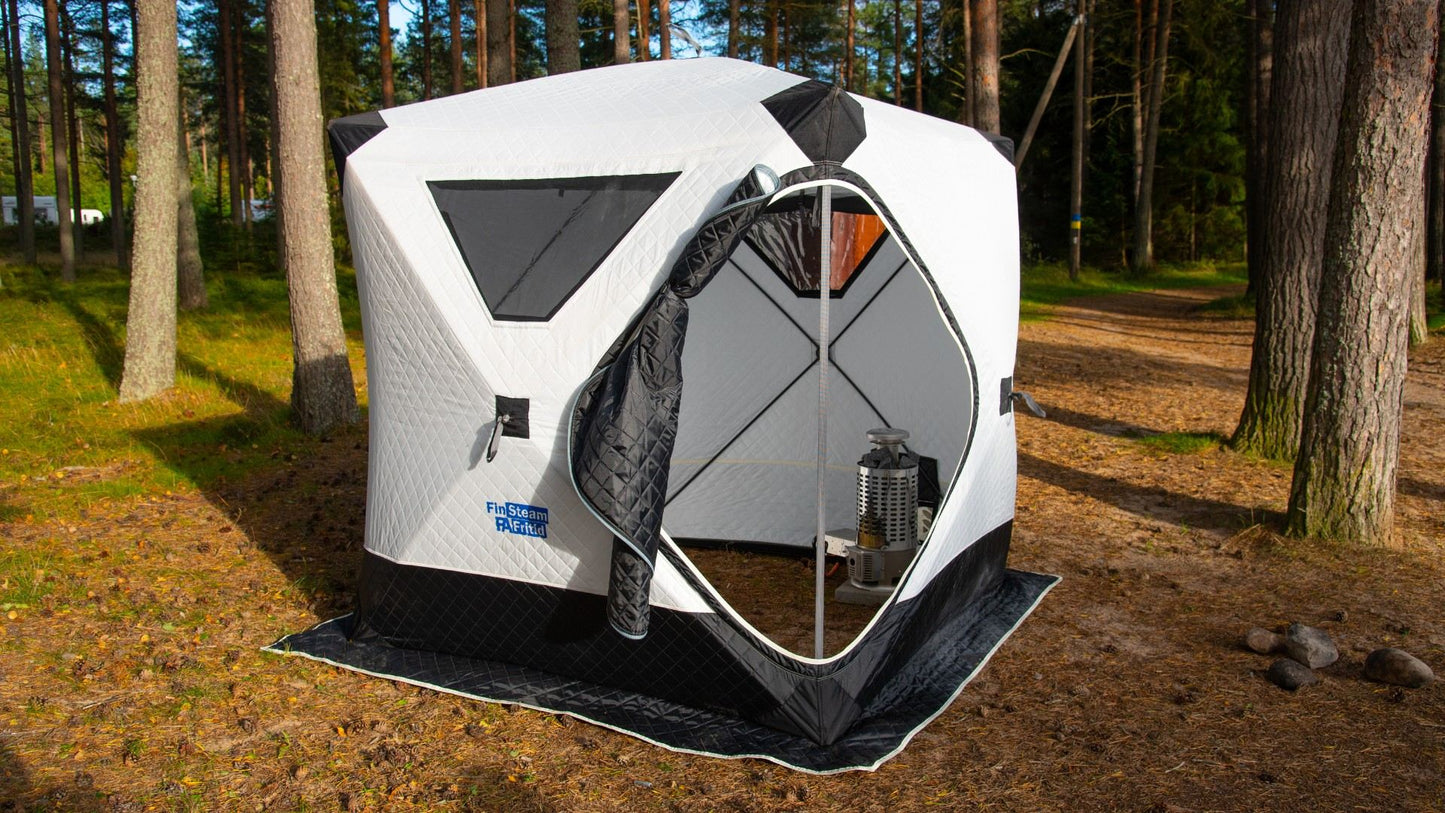
- FinSteam Fritid tent — if you're building a portable setup around the heater rather than retrofitting an existing structure.
Delivery + documents
Free UK delivery on the heater. Stock status and lead time shown above the buy button.
Documents available on request: EU Type-Examination Certificate (AENOR) · EU Declaration of Conformity · Installation & safety manual · Ventilation specification · UK gas connection guide.
FAQs — retrofit-focused
I have an existing wood-fired barrel sauna. Can I convert it to gas with the Botnia?
Yes — and it's one of the most common retrofit scenarios we see. Remove the wood stove and its flue, seal the flue penetration in the roof, fit the Botnia 81 on a non-combustible base in the same position (the sauna will already have approximately the right airflow because it was designed around the wood stove). You'll need to fit FinSteam-spec natural ventilation if the existing vents are mechanical / closable plastic disc types. Most barrel sauna conversions need the R11S configuration (Njord heat shield to reduce the clearance to the curved timber walls). Send us a photo of your barrel before you order — we'll tell you what you need.
My electric sauna heater has died. Can I swap it for the Botnia?
Yes — and you save the £1-2k electrician cost for replacing the electrical install. Remove the old electric heater and its wiring (electrically isolate properly). Fit the Botnia on a non-combustible base — most electric saunas already have the right base. You'll need to add a wall gland for the gas hose, and provide natural ventilation if the existing was mechanical. The cabin's existing insulation works fine for gas — you're just changing the heat source. Worth checking the cabin volume sits within the Botnia's 4-12 m³ insulated spec before you commit.
Will it fit my cube / cabin sauna with limited clearance?
Almost certainly — the standard 200 mm side clearance fits most cube and cabin saunas (4-8 m³). For very tight installs, the Njord heat shield (R11S / R14S) brings the required side clearance down to 50 mm.
Do I need a Gas Safe engineer to install this in my existing sauna?
Depends on the install. If you use it portably (heater stands on the base, propane bottle outside, gas hose runs through a wall gland) — no, you don't. If you permanently fix the heater into the sauna structure (anchored, gas line routed and fixed) — yes, UK regulations require a Gas Safe registered engineer for the gas connection. Most retrofit installs go the fixed route because it's neater.
What about ventilation in my existing barrel — what do I need to check?
FinSteam require natural (gravity) ventilation only. Air intake ≥350 cm² low next to the heater, taken from outside. Air exhaust ≥250 cm² high in the opposite corner, discharged directly to outside. Wooden louvre vents — NOT plastic disc valves (FinSteam specifically exclude these). If your existing sauna has plastic disc vents, you'll need to swap them. If it has mechanical / fan ventilation, you need to remove it — gas heaters cannot be used with mechanical ventilation.
How does the Botnia compare to the Aurora 81?
Same 8.1 kW chassis, same patented burner, same certifications, same safety case, same heat-up time, same löyly response, same heating performance. The Aurora is FinSteam's newer premium line — more modern design language, intended for builds where the heater is part of the aesthetic. The Botnia is the original — slightly lower price, identical performance. If function-per-pound matters most, the Botnia is the smarter buy. If you want the newest FinSteam product, look at the Aurora 81.
What stones go in the cage — can I use barbecue lava rocks?
No — sauna stones are specifically sized and selected for thermal cycling. Lava rocks crack and shatter under repeated heating. Use proper FinSteam sauna stones, sized for the Orbis cage. They last 2-3 years of heavy use; 40 kg is enough to fill the cage with proper thermal density.
How the gas heat works — sauna-ready in under 20 minutes
Electric and wood heaters warm the room indirectly: they heat a big mass of stones first, which slowly warms the air — 30 to 45 minutes of waiting or fire-tending. A FinSteam gas heater is flueless and heats directly: it burns gas cleanly and puts the hot air and water vapour straight into the cabin, while the stones still heat for löyly. Nothing is stored first, nothing is lost up a chimney — so it's sauna-ready in under 20 minutes, on a dial. It also carries a soft, natural humidity from the moment it lights.
Full explainer: how a gas sauna heater works. Weighing up fuels? Wood-fired vs gas vs electric.
Heat-up time is typical tent set-up (manufacturer guidance); varies with sauna size, insulation and ventilation.
The science behind it — FinSteam's engineering framework
Direct Thermal Flow™. Heat from combustion reaches the sauna air, the stones and the structure simultaneously, from the first minute — instead of being stored in a stone mass first and released slowly. Same physics as any sauna; a fundamentally different engineering configuration.
Humidity Balance™. Clean LPG combustion continuously releases gentle water vapour into the cabin, so the sauna starts with a pleasant base humidity instead of the harsh dry heat before the first ladle. Löyly works exactly as normal — this sits underneath it, it doesn't replace it.
Sauna Climate Engineering™. Heat, moisture, thermal storage, airflow and ventilation managed as one coordinated system — not one number on a dial.
Why the kW number misleads
An independent, FINAS-accredited energy laboratory (Kymenlaakso University of Applied Sciences, Finland) tested seven wood-fired sauna heaters rated ~20 kW: measured heat output was just 57–72% of the nameplate figure, with 28–43% of the heat going straight up the chimney. A FinSteam heater is flueless — there is no chimney to lose heat up, so virtually all combustion heat, including the latent heat carried in the water vapour, stays inside the sauna. That's why an 8.1 kW FinSteam outperforms its label — you can't compare nameplate kW across heater types.
An 11 kg cylinder runs ≈ 18 hours at continuous full power — and real sessions use less, because full power is mainly for heat-up.
Lab study source: TM Rakennusmaailma / Kymenlaakso UAS study of wood-fired heaters; FinSteam was not part of that test. FinSteam's trademarked engineering framework · EU Type Examination Certificate A01/002220 (AENOR) · EN 449 · Independently tested by Applus+ Laboratories.
No electrician. No chimney. Off-grid.
It runs on a standard propane bottle, so there's no electrician, no dedicated circuit and no Part P sign-off — the £800–£1,500 line item that catches out electric-sauna buyers. No chimney means no smoke and no problem in a smoke-control area. Propane keeps working through a British winter, so it's a genuine year-round, go-anywhere sauna. Running cost is about £2-£3 a session - nearer £3 on a portable 6 kg gas bottle, or £2-£2.50 on an economy 13 kg bottle. That's roughly level with an electric sauna: you choose gas for what it removes - the electrician, the wiring and the wait - not to cut your energy bill.
The safety engineering
Gas in an enclosed space deserves serious engineering. Every FinSteam heater has an Oxygen Depletion Sensor (ODS) that shuts the gas off automatically if oxygen drops too low, flame supervision that cuts the gas the instant the flame is lost, and push-button piezo ignition. The cylinder always stays outside — only the hose enters — and correct ventilation is part of every install. EU type-examination certified under the Gas Appliance Regulation (2016/426).
Why gas wins in busy and commercial saunas
The hardest thing for any public or mobile sauna is the door: every time it opens, hot air escapes and cold pours in. An electric or wood heater then sags while it slowly rebuilds heat from the stones. A flueless gas heater produces heat continuously and replaces the lost hot air the moment it escapes — so it holds temperature through constant use. It's why a well-specified 8.1 kW FinSteam heater keeps up where you'd expect to need far more power. The 12-month warranty applies to commercial use.
Build your package
The Botnia 81 is the heater in our Ember Base and Ember Complete packages — or build your own setup with the Fritid X tent, a folding cedar bench and the propane regulator kit. Step up to the Aurora 81 for the 60-minute safety timer. Browse the full gas sauna range.
Share